
Gait cycle in physiotherapy, including gait definition, cycle duration, stance and swing phases, key events and gait analysis with detailed diagrams.
Definition
Gait: Human locomotion, or gait, may be described as a translatory progression of the body as a whole, produced by coordinated, rotatory movements of body segments.
Gait Cycle: Define as spans two successive events of the same limb, usually initial contact of the lower extremity with the supporting surface.
Phases of Gait Cycle:
Each gait cycle has two phases:
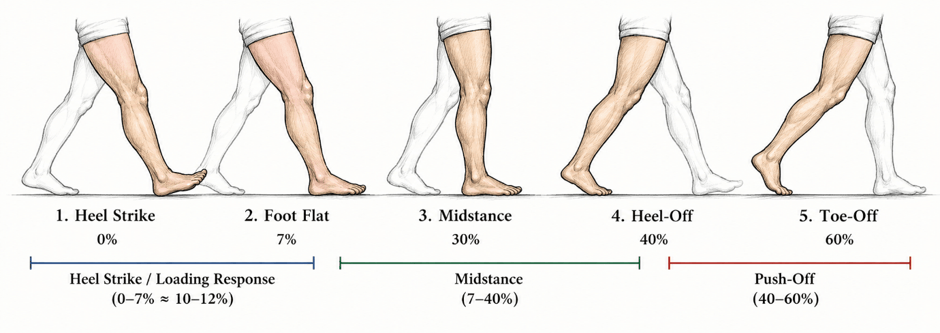
- Stance phase: When some part of the foot is in contact with the floor, which makes up about 60% of the gait cycle.
- Swing phase: When the foot is not in contact with the floor, which makes up 40% of gait cycle.
Stance Phase
Stance phase has five events
- Initial Contact: The instant the leading foot first contacts the ground. In normal gait, contact occurs at the heel and is termed heel contact or heel strike. In abnormal gait, initial contact may occur with the whole foot or toes.
- Foot Flat: The first instant during stance when the entire foot is in contact with the ground, occurring at approximately 7% of the gait cycle.
- Midstance: The point when the body weight is positioned directly over the supporting lower extremity, occurring at approximately 30% of the gait cycle.
- Heel-Off: The instant when the heel of the reference foot leaves the ground, occurring at approximately 40% of the gait cycle.
- Toe-Off: The instant when the toes of the reference foot leave the ground, marking the end of the stance phase, at approximately 60% of the gait cycle.
Swing phase
Swing phase has three events
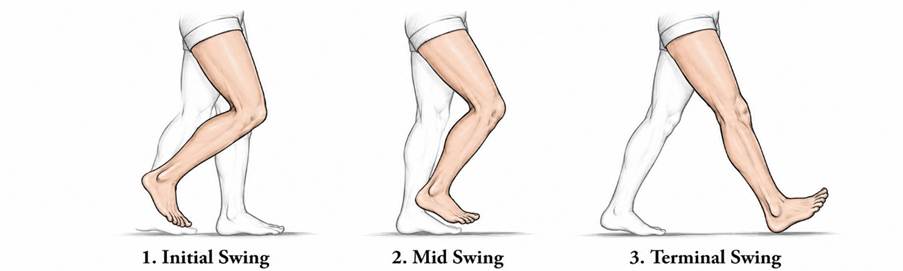
- Early Swing (Initial Swing): Begins at toe-off and continues until the swinging limb passes directly beneath the body. It is also called the acceleration phase.
- Mid Swing: Occurs as the swinging limb passes beneath the body, marking the transition from acceleration to deceleration.
- Late Swing (Terminal Swing): Begins after midswing as the limb decelerates and prepares for initial contact (heel strike). It is also called the deceleration phase.
Get All Physiotherapy Notes & Updates — Enter your Email and Follow
Reference:
- Levangie, P. K., & Norkin, C. C. (Eds.). (2011). Joint structure and function: A comprehensive analysis (5th ed.). F.A. Davis Company.
- Kisner, C., & Colby, L. A. (2007). Therapeutic exercise: Foundations and techniques (5th ed.). F.A. Davis Company.
For more notes click on: www.physiotherapyphd.com


12 thoughts on “Gait Cycle: Definition, Phases and Gait Analysis with Diagrams”