
Learn about gait analysis, spatial and temporal variables such as stride length, step length, cadence, gait speed and gait cycle time.
Definition
Gait: Human locomotion, or gait, may be described as a translatory progression of the body, produced by coordinated, rotatory movements of body segments.
Gait Cycle: Define as spans two successive events of the same limb, usually initial contact of the lower extremity with the supporting surface.
The Spatial variables include stride length, step length and width, and degree of toe-out.
Temporal variables include stance time, single-limb and double-support time, swing time, stride and step time, cadence, and speed.
Spatial variables:
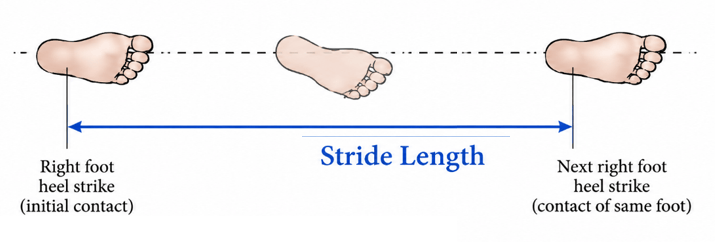
Stride Length: Stride length is the linear distance between two successive points of contact of the same lower extremity during gait. For example, it is the distance from the heel strike of one foot to the next heel strike of the same foot.
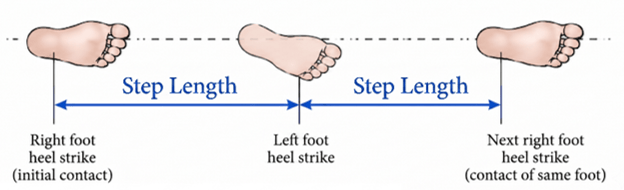
Step Length: Step length is the linear distance between two successive points of contact of opposite extremities. It is usually measured from the heel strike of one extremity to the heel strike of the opposite extremity.
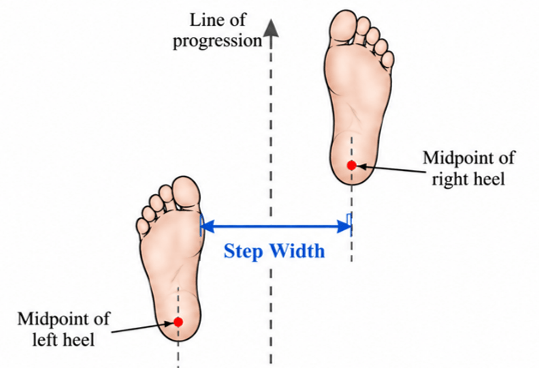
Step Width: Step width, also called the width of the walking base, is the linear distance between the midpoint of the heel of one foot and the corresponding midpoint of the heel of the opposite foot.
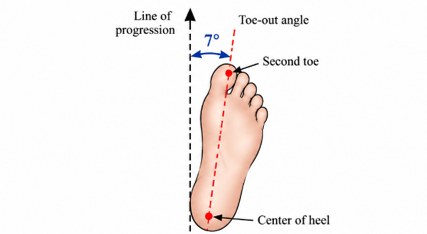
Degree of Toe-Out: The degree of toe-out represents the angle at which the foot is placed relative to the line of progression during walking. It is measured as the angle between the line of progression of the foot and a line passing through the center of the heel and the second toe. During free-speed walking, the toe-out angle in men is normally approximately 7° from the line of progression of each foot.
Temporal variables:
Stance Time: Stance time is the amount of time that elapses during the stance phase of one extremity in a gait cycle, from initial contact to toe-off of the same extremity.
Swing Time: Swing time is the amount of time that elapses during the swing phase of one extremity, from toe-off until the next initial contact of the same extremity.
Single-Support Time: Single-support time is the amount of time during which only one lower extremity is in contact with the supporting surface during a gait cycle.
Double-Support Time: Double-support time is the amount of time during which both feet are simultaneously in contact with the ground during a gait cycle.
Step Time (Step Duration): Step time is the amount of time required to complete a single step, measured from an event involving one lower extremity to the corresponding event involving the opposite extremity.
Stride Time: Stride time is the time required to complete one full gait cycle, measured from one initial contact of a lower extremity to the next initial contact of the same extremity.
Cadence: Cadence is the number of steps taken per unit of time, usually expressed as steps per minute. At a given walking velocity, a shorter step length generally results in a higher cadence. Cadence and stride length show a generally linear relationship within the normal range of walking speeds.
Walking Velocity: Walking velocity is the rate of forward linear movement of the body during walking. It may be expressed in meters per second (m/s), centimeters per second, meters per minute, or miles per hour. In scientific literature, meters per second (m/s) is commonly used.
Formula: Walking velocity (m/s) = Distance walked (m) ÷ Time taken (s)
Get All Physiotherapy Notes & Updates — Enter Email and Follow
Reference:
- Levangie, P. K., & Norkin, C. C. (Eds.). (2011). Joint structure and function: A comprehensive analysis (5th ed.). F.A. Davis Company.
- Kisner, C., & Colby, L. A. (2007). Therapeutic exercise: Foundations and techniques (5th ed.). F.A. Davis Company.
For more notes click on: www.physiotherapyphd.com


12 thoughts on “Gait Analysis: Definition, Spatial and Temporal Variables”