
Learn about Waddling gait, including its definition, causes, characteristic walking pattern, muscle weakness, clinical features and conditions associated with this abnormal gait.
Waddling or Wobbling Gait: Causes, Features and Clinical Conditions
Learn about waddling gait, including its definition, causes, characteristic walking pattern, muscle weakness, clinical features and conditions associated with this abnormal gait.
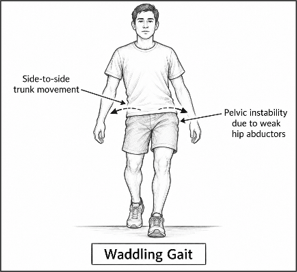
Definition: Waddling gait is a pathological gait characterized by side-to-side trunk movement and pelvic instability during walking, giving the appearance of a “waddle.”
If the hip abductor muscles (gluteus medius and minimus) are weak, the stabilizing effect of these muscles during stance phase is lost, and the patient exhibits an excessive lateral twist in which the thorax is thrust laterally to keep the center of gravity over the stance leg.
The most important mechanism is weakness of the hip abductors, particularly: Gluteus medius, Gluteus minimus, Tensor fasciae latae. Normally, these muscles stabilize the pelvis when the opposite leg is lifted during walking.
If there is bilateral weakness of the gluteus medius muscles, the gait shows accentuated side-to side movement, resulting in a “wobbling” gait or “chorus girl swing.” This gait may also be seen in patients with congenital dislocation of the hip and coxa vara.
Common causes:
- Duchenne muscular dystrophy
- Poliomyelitis
- Bilateral hip pathology
- Congenital hip dislocation/dysplasia
- Pregnancy
- Severe bilateral Trendelenburg weakness
Trendelenburg gait: Usually associated with unilateral hip abductor weakness, Pelvis drops on the opposite side during single-leg stance.
Waddling gait: Usually associated with bilateral hip/proximal muscle weakness, Pelvis becomes unstable on both sides, producing a characteristic side-to-side trunk/pelvic movement.
Get All Physiotherapy Notes & Updates — Enter Email and Follow
Joint Movements During Gait: Sagittal, Frontal and Transverse Plane Motions
Gait Analysis: Definition, Spatial and Temporal Variables
Gait Cycle: Definition, Phases and Gait Analysis with Diagrams
References: Magee, D. J. Orthopedic Physical Assessment. 7th ed. St. Louis, MO: Elsevier; 2021.
For more notes click on:


One thought on “Waddling Gait: Causes, Characteristics and Clinical Features”