
Learn about Trendelenburg gait, including its definition, causes, characteristic walking pattern, hip abductor weakness and associated clinical conditions.
Definition:
Trendelenburg gait is an abnormal gait pattern caused primarily by weakness or dysfunction of the hip abductors, especially the gluteus medius and gluteus minimus.
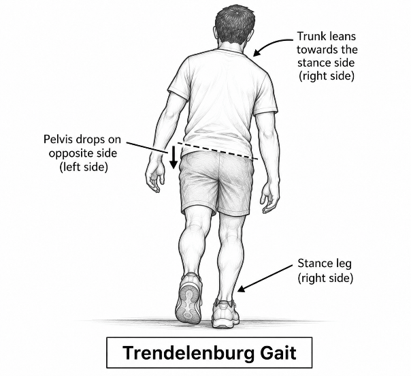
Characteristic of Trendelenburg gait
Due to the weakness of the Gluteus medius muscle, Pelvis drops on the opposite side, trunk leans towards the affected side, wide BOS
Causes
- Superior gluteal nerve injury
- Gluteus medius/minimus weakness
- Hip joint pathology
- Hip surgery or hip replacement
- Developmental dysplasia of the hip
- Painful hip conditions
- Neuromuscular disorders
- Leg-length discrepancy
Get All Physiotherapy Notes & Updates — Enter Email and Follow
Joint Movements During Gait: Sagittal, Frontal and Transverse Plane Motions
Gait Analysis: Definition, Spatial and Temporal Variables
Gait Cycle: Definition, Phases and Gait Analysis with Diagrams
Reference:
- O’Sullivan SB, Schmitz TJ, Fulk GD. Physical Rehabilitation. Elsevier.
- Magee DJ. Orthopedic Physical Assessment. Elsevier.


One thought on “Trendelenburg Gait: Causes, Characteristics and Clinical Features”