
Parkinsonian gait, including its characteristic walking pattern, short shuffling steps, reduced arm swing, stooped posture, freezing of gait and associated features of Parkinson’s disease.
Definition
Parkinsonian gait is an abnormal gait pattern commonly associated with Parkinson’s disease, characterized by short, shuffling steps, reduced arm swing, difficulty initiating movement, and a tendency to accelerate forward.
Parkinsonian gait characteristics:
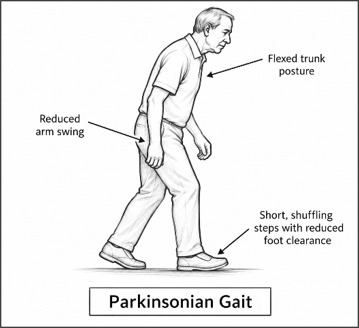
- Shuffling gait: The patient takes small, short steps with reduced foot clearance, causing the feet to appear to shuffle along the floor.
- Festinating gait: The patient progressively accelerates forward, taking increasingly rapid and shorter steps, as if trying to catch up with the body’s forward movement.
- Freezing of gait: A sudden, brief inability to move the feet despite the intention to walk. It is particularly common when: Initiating gait, Turning, Changing direction
- Typical Posture: Flexed trunk, flexed hips and knees, reduced arm swing, small steps
The neck, trunk, and knees of a patient with parkinsonian gait are flexed.
The arms are held stiffly and do not have their normal associative movement
Reference:
- O’Sullivan SB, Schmitz TJ, Fulk GD. Physical Rehabilitation. Elsevier.
- Magee DJ. Orthopedic Physical Assessment. Elsevier.
Joint Movements During Gait: Sagittal, Frontal and Transverse Plane Motions
Gait Analysis: Definition, Spatial and Temporal Variables
Gait Cycle: Definition, Phases and Gait Analysis with Diagrams
For more notes click on: www.physiotherapyphd.com

