
Manual traction technique in physiotherapy, including its principles, types, application techniques, indications, contraindications, physiological effects and clinical uses.
Definition:
Traction and distraction are different techniques.
- Traction: A pulling force applied along the long axis of a bone. It may produce a glide rather than separation of the joint surfaces.
- Distraction: A force that pulls the joint surfaces apart, producing joint separation.
Sustain glides includes the distraction Technique
Techniques
This grading system describes only joint-play techniques that separate (distract) or glide/translate (slide) the joint surfaces.
Grades of Traction:
Grade I (Loosen): Small-amplitude distraction is applied without putting stress on the joint capsule. It helps reduce the effects of cohesive forces, muscle tension, and atmospheric pressure acting on the joint.
Grade II (Tighten): Enough distraction or glide is applied to tighten the tissues around the joint. This is called “taking up the slack.”
Grade III (Stretch): Distraction or glide is applied with a large enough amplitude to stretch the joint capsule and surrounding tissues.
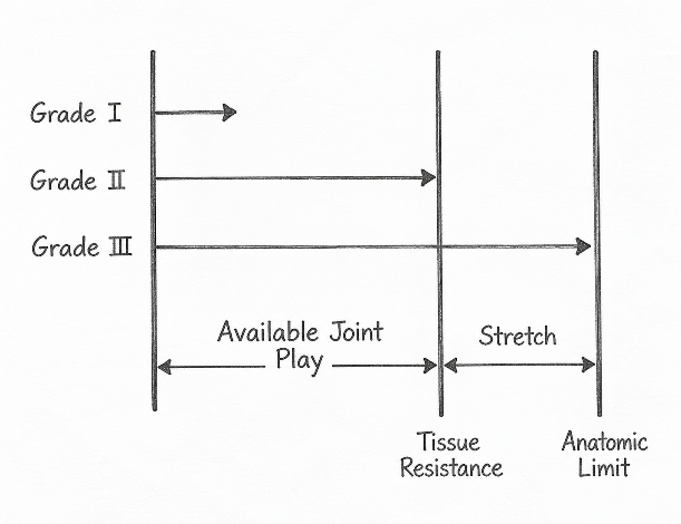
Effects of Traction Techniques:
Grade I – Loosen: Used with all gliding techniques and may help relieve pain.
Grade II – Tighten: Used initially to assess joint sensitivity and determine the appropriate treatment dosage. Gentle intermittent distraction may help reduce pain. Grade II glides can maintain joint play when ROM is restricted.
Grade III – Stretch: Used to stretch the joint capsule and surrounding structures and increase joint play.
Get All Physiotherapy Notes & Updates — Enter your email and Follow
Reference:
- Levangie, P. K., & Norkin, C. C. (Eds.). (2011). Joint structure and function: A comprehensive analysis (5th ed.). F.A. Davis Company.
- Kisner, C., & Colby, L. A. (2007). Therapeutic exercise: Foundations and techniques (5th ed.). F.A. Davis Company.
For more notes click on: www.physiotherapyphd.com

