
Upper trapezius stretching techniques, including self-stretching, therapist-assisted stretching, patient positioning, step-by-step procedures, precautions and benefits for neck flexibility and mobility.
Introduction
The trapezius is a large, superficial, triangular muscle covering the posterior aspect of the neck and upper back. It is divided into three functional parts:
- Upper fibres: Elevate and assist in upward rotation of the scapula.
- Middle fibres: Retract (adduct) the scapula.
- Lower fibres: Depress and assist in upward rotation of the scapula.
The upper trapezius is commonly stretched to improve cervical flexibility and reduce muscle tightness around the neck and shoulder region. The technique described below specifically targets the upper fibres of the trapezius
Upper Trapezius Stretch – Manual Technique
Purpose: To elongate the upper fibres of the trapezius muscle and improve flexibility of the cervical region.
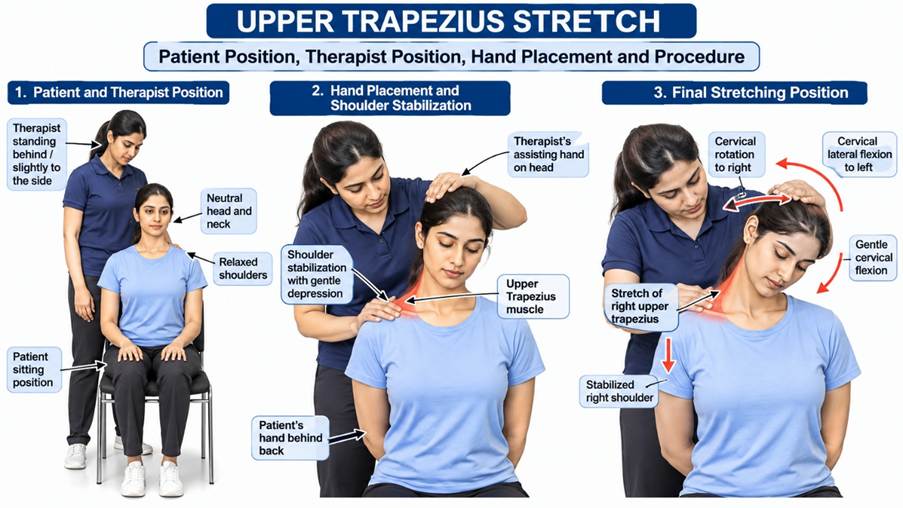
Patient Position
Position the patient in a comfortable sitting position on a chair.
Ask the patient to maintain an upright trunk with the shoulders relaxed.
Ensure that the head and neck are initially in a neutral position.
Therapist Position
Stand behind or slightly to the side of the patient.
Ensure proper body mechanics and maintain adequate control while applying the stretch.
Hand Placement and Procedure
1. Stabilize the shoulder: Ask the patient to place the hand of the side being stretched behind the back. Alternatively, the therapist may use one hand to stabilize and gently depress the shoulder girdle on the side being stretched.
2. Position the head: Ask the patient to rotate the head towards the side being stretched.
3. Apply cervical lateral flexion: Gently move the head into lateral flexion towards the opposite shoulder.
4. Add cervical flexion: Introduce gentle forward flexion of the neck to increase the stretch along the upper trapezius fibres.
5. Apply gentle assistance: Place the therapist’s other hand over the side or posterior aspect of the head and gently guide it further into the combined movement, without applying excessive force.
6. Maintain the stretch: Continue until a mild stretching sensation is felt along the posterolateral aspect of the neck, extending towards the upper shoulder.
7. Return to the starting position: Slowly release the stretch and bring the patient’s head back to the neutral position.
Dosage and Duration
| Parameter | Recommendation |
| Holding duration | 20–30 seconds |
| Repetitions | 2–3 times |
| Sets | 1–2 sets |
References
1. StatPearls – Anatomy, Back: Trapezius.
2. Therapeutic Exercise: Foundations and Techniques – Upper Trapezius Stretch.
3. Kinesiologic Considerations for Targeting Activation of Scapulothoracic Muscles – Trapezius.
Get All Physiotherapy Notes & Updates — Enter Email and Follow
Joint Movements During Gait: Sagittal, Frontal and Transverse Plane Motions
Gait Analysis: Definition, Spatial and Temporal Variables
Gait Cycle: Definition, Phases and Gait Analysis with Diagrams
For more notes click on:

