
Explore dynamic stretching, including its definition, techniques, common exercises, physiological effects, benefits, precautions and applications in flexibility training and physiotherapy.
Definition
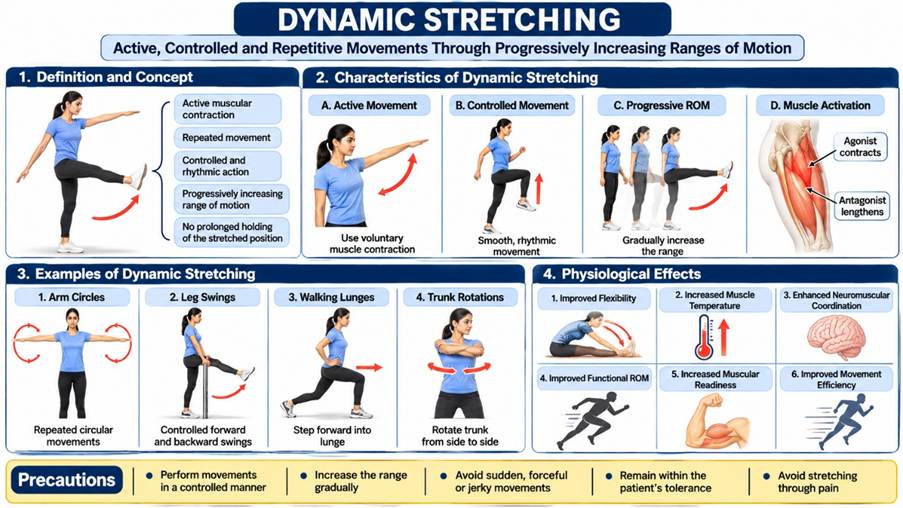
Dynamic stretching is a form of active stretching in which a body segment is moved repeatedly and smoothly through its available range of motion (ROM), gradually increasing the range of movement to elongate the targeted muscles and improve flexibility.
Characteristics of Dynamic Stretching
- Active Movement: The patient independently performs the stretching movement using voluntary muscle contractions.
- Controlled Movements: Movements are performed smoothly and rhythmically without sudden or jerky actions.
- Progressive Range of Motion: The range of movement is gradually increased with successive repetitions, according to the patient’s tolerance.
- Muscle Activation: Both agonist and antagonist muscle groups participate in coordinated movement, with the opposing muscle group contributing to the lengthening of the targeted muscles.
- Repetitive Movement: Stretching is achieved through repeated movements rather than maintaining a static position.
Physiological Effects of Dynamic Stretching
- Improves Flexibility: Promotes progressive improvement in muscle flexibility and joint mobility.
- Increases Muscle Temperature: Repeated muscular activity increases local muscle temperature and prepares tissues for physical activity.
- Enhances Neuromuscular Coordination: Improves coordination between agonist and antagonist muscle groups.
- Improves Functional ROM: Facilitates movement through a greater range of motion required for functional and physical activities.
- Increases Muscular Readiness: Activates the neuromuscular system and prepares muscles for subsequent physical activity.
- Improves Movement Efficiency: Promotes smooth, coordinated and controlled movement patterns.
Precautions
- Movements should be controlled and performed within the patient’s tolerance.
- Avoid sudden, forceful or jerky movements.
- The range of movement should be increased gradually.
- Avoid dynamic stretching in the presence of acute musculoskeletal injury or significant pain without appropriate clinical assessment.
References
- Kisner, C., Colby, L. A., & Borstad, J. (2017). Therapeutic Exercise: Foundations and Techniques (7th ed.). F. A. Davis Company.
- Dutton, M. (2020). Dutton’s Orthopaedic Examination, Evaluation, and Intervention (5th ed.). McGraw Hill.
- Neumann, D. A. (2017). Kinesiology of the Musculoskeletal System: Foundations for Rehabilitation (3rd ed.). Elsevier.
For more notes click on:

