
Master the concepts of axes and planes in kinesiology with detailed explanations, movement examples, anatomical relationships and clinical importance for physiotherapy students.
AXIS
Definition
An axis is an imaginary line around which a body segment or joint rotates during movement.
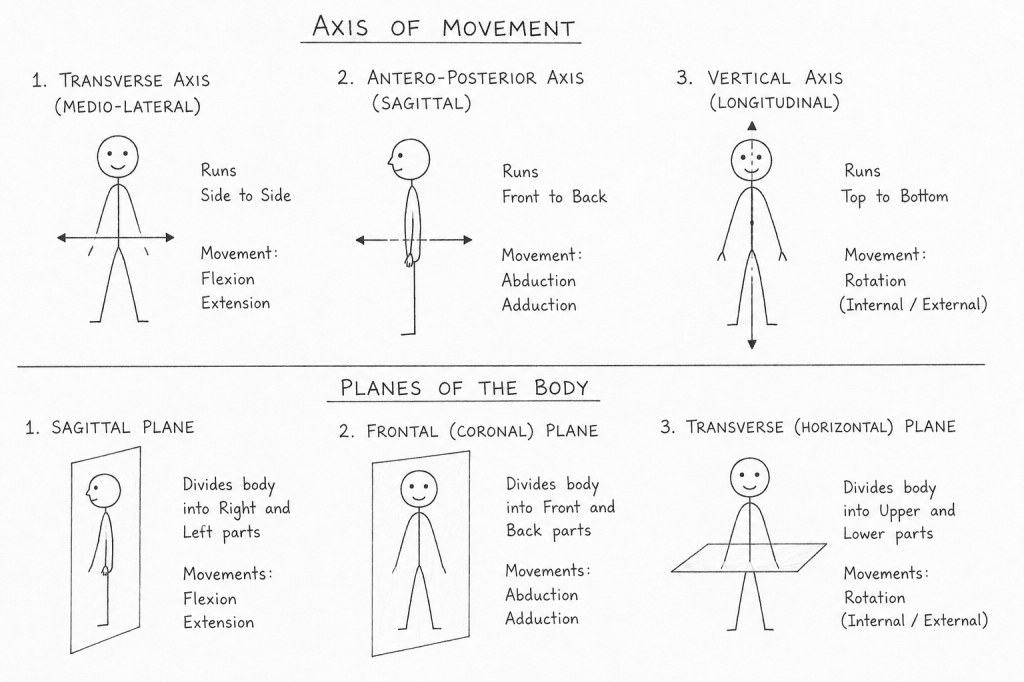
In Biomechanics & Exercise Therapy, movement occurs in a plane and rotates around an axis that is perpendicular to that plane.
Types of Axes
| Axis | Direction | Associated Plane | Example Movement |
| Mediolateral (Frontal) Axis | Side to side | Sagittal Plane | Flexion and Extension of knee, elbow |
| Anteroposterior (Sagittal) Axis | Front to back | Frontal Plane | Abduction and Adduction of shoulder, hip |
| Vertical (Longitudinal) Axis | Up and down | Transverse Plane | Rotation of head, trunk, shoulder |
Examples
Knee Flexion and Extension
Movement Plane: Sagittal Plane
Axis: Mediolateral Axis
Shoulder Abduction
Movement Plane: Frontal Plane
Axis: Anteroposterior Axis
Neck Rotation
Movement Plane: Transverse Plane
Axis: Vertical Axis
Sagittal Plane → Mediolateral Axis
Frontal Plane → Anteroposterior Axis
Transverse Plane → Vertical Axis
Remember: Movement occurs in a plane and rotates around an axis perpendicular to that plane.
Plane is a flat surface
Axis is an imaginary line
For more notes click on: www.physiotherapyphd.com

