
Understand the concepts of anatomical planes and axes with detailed explanations, movement examples and clinical applications for physiotherapy and biomechanics.
Definition of Plane
A plane is an imaginary flat surface passing through the body that divides it into sections. Human movements occur within these planes.
Types:
- Sagittal Plane
- Frontal plane
- Traverse Plane
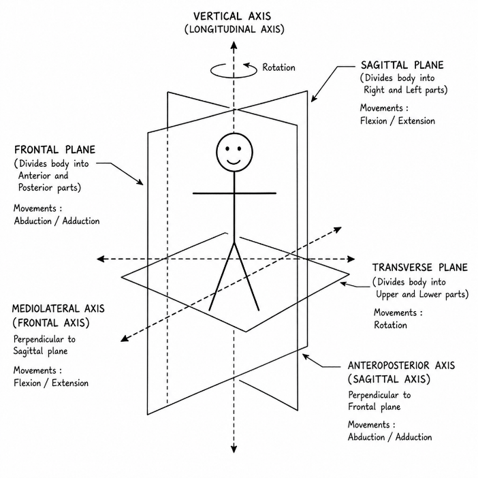
Types of Planes
1. Sagittal Plane
- Divides the body into right and left halves.
- Movements occur forward and backward.
Examples:
- Neck flexion and extension
- Elbow flexion and extension
- Knee flexion and extension
- Ankle dorsiflexion and plantarflexion
2. Frontal (Coronal) Plane
- Divides the body into anterior (front) and posterior (back) parts.
- Movements occur sideways.
Examples:
- Shoulder abduction and adduction
- Hip abduction and adduction
- Lateral flexion of trunk and neck
3. Transverse (Horizontal) Plane
- Divides the body into upper and lower parts.
- Movements occur around the vertical axis.
Examples:
- Rotation of head and neck
- Trunk rotation
- Shoulder internal and external rotation
- Forearm pronation and supination
Definition Axis
An axis is an imaginary line around which a body segment rotates during movement.
Important Rule:
Movement occurs in a plane and rotates around an axis perpendicular to that plane.
Types of Axes
1. Mediolateral Axis (Frontal Axis)
- Runs from one side of the body to the other.
- Perpendicular to the sagittal plane.
Movements Around This Axis
- Flexion
- Extension
Examples
- Knee flexion-extension
- Elbow flexion-extension
- Neck flexion-extension
2. Anteroposterior Axis (Sagittal Axis)
- Runs from front to back.
- Perpendicular to the frontal plane.
Movements Around This Axis
- Abduction
- Adduction
Examples
- Shoulder abduction-adduction
- Hip abduction-adduction
3. Vertical (Longitudinal) Axis
- Runs from head to foot.
- Perpendicular to the transverse plane.
Movements Around This Axis
- Rotation
Examples
- Trunk rotation
- Neck rotation
- Shoulder internal and external rotation
Relationship Between Planes and Axes
| Plane | Divides Body Into | Axis Perpendicular to Plane | Common Movements |
| Sagittal Plane | Right and Left | Mediolateral Axis | Flexion, Extension |
| Frontal Plane | Front and Back | Anteroposterior Axis | Abduction, Adduction |
| Transverse Plane | Upper and Lower | Vertical Axis | Rotation |
Clinical Importance in Physiotherapy
- Helps in analysis of normal and abnormal movement.
- Essential for goniometric measurement of joint motion.
- Useful in gait analysis.
- Assists in exercise prescription and rehabilitation.
- Important for posture assessment and biomechanical evaluation.
Reference
Norkin CC, Levangie PK. Joint Structure and Function. 6th Edition. F.A. Davis Company.
Hall SJ. Basic Biomechanics. 9th Edition. McGraw-Hill Education.
For more notes click on: www.physiotherapyphd.com

