
Progressive Resisted Exercises (PRE): Principles, Types, Advantages and Physiotherapy Note, PDF-PRE, Definition
Definition: Progressive resistance exercise (PRE) is a system of dynamic resistance training in which a constant external load is applied to the contracting muscle by some mechanical means (usually a free weight or weight machine) and incrementally increased.
The repetition maximum (RM) is used as the basis for determining and progressing the
resistance.
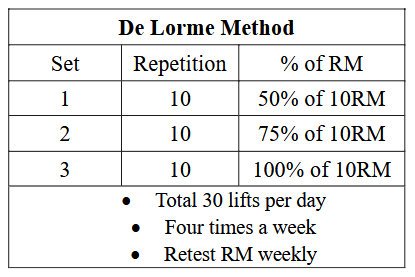
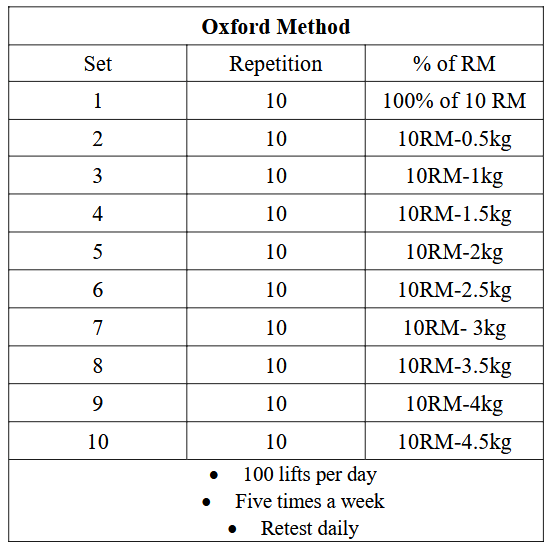
Delorme and Oxford Regimens: The concept of PRE was introduced by DeLorme, who
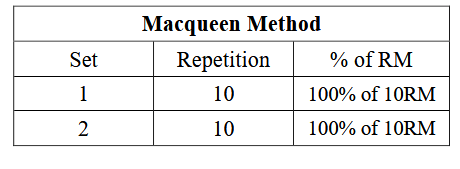
originally used the term heavy resistance training and later load-resisting exercise to describe a new system of strength training. DeLorme proposed and studied the use of three sets of a 10 RM with progressive loading during each set. Other investigators developed a regimen, the Oxford technique, with regressive loading in each set.
The DeLorme technique builds a warm-up period into the protocol, whereas the Oxford
technique diminishes the resistance as the muscle fatigues.
In general, training-induced strength gains occur with two to three sets of 6 to 12 repetitions of a 6 to 12 RM.
DAPRE Regimen: The Daily Adjustable Progressive Resistive Exercise (DAPRE) technique is more systematic and takes into account the different rates at which individuals progress during rehabilitation or conditioning programs.
The system is based on a 6 RM working weight. The adjusted working weight, which is based on the maximum number of repetitions possible using the working weight in Set-3 of the regimen, determines the working weight for the next exercise session.
Reference:
1. Practical exercise therapy/edited by Margaret Hollis and Phyl Fletcher-Cook; Patricia J. Waddington. —4th ed.
2. Kisner, Carolyn. Therapeutic exercise: foundations and techniques / Carolyn Kisner,
Lynn Allen Colby. — 5th ed.

