
Explore piriformis stretching techniques, including self-stretching, manual stretching by a therapist, step-by-step procedures, precautions, contraindications and benefits for hip flexibility and mobility.
Definition
Piriformis stretching is a therapeutic technique used to lengthen the piriformis muscle, reduce muscle tightness, improve hip mobility, and relieve movement-related discomfort. It may be performed independently by the patient (self-stretching) or with the assistance of a physiotherapist (manual stretching)
Anatomy
The piriformis is a deep muscle of the gluteal region that originates from the anterior surface of the sacrum and inserts onto the greater trochanter of the femur. It primarily acts as a lateral rotator of the hip when the hip is extended and assists with hip abduction when the hip is flexed.
Indications
Tightness or adaptive shortening of the piriformis muscle.
Reduced hip range of motion, particularly in movements that lengthen the piriformis.
Muscular discomfort in the gluteal region associated with piriformis tightness.
Reduced flexibility following prolonged sitting or reduced physical activity.
Selected cases of deep gluteal pain where stretching is clinically appropriate.
As part of a rehabilitation programme to improve hip mobility and movement function.
Piriformis Self-Stretching
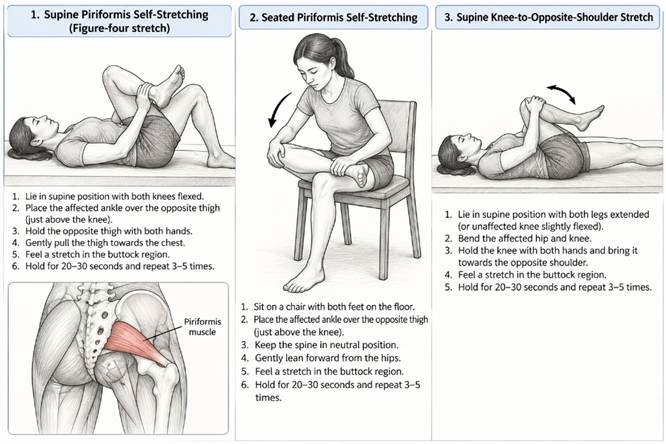
- Supine Piriformis Self-Stretching
Starting position:
The patient lies in the supine position on a firm treatment couch or exercise mat.
Both knees are flexed, with the feet resting on the surface.
Procedure:
- The patient lifts the affected leg and places its ankle over the opposite thigh, just above the knee, forming a figure-four position.
- The patient holds the unaffected thigh with both hands.
- The unaffected thigh is gently pulled towards the chest.
- The affected hip moves into flexion, adduction, and external rotation, producing a stretch in the buttock region.
- The position is maintained without bouncing or forcing the movement.
- The patient slowly returns to the starting position.
Dosage: Hold for 20–30 seconds and repeat 3–5 times, according to tolerance.
- Seated Piriformis Self-Stretching
Purpose: To stretch the piriformis in a sitting position, particularly when floor-based exercises are difficult.
Starting position:
The patient sits upright on a stable chair with both feet supported on the floor.
Procedure:
- The patient places the ankle of the affected leg over the opposite thigh, just above the knee.
- The spine is maintained in a neutral position.
- The patient gently hinges forward at the hips while keeping the back relatively straight.
- The forward movement is continued until a mild stretch is felt in the buttock of the affected side.
- The position is held without bouncing.
- The patient returns slowly to the starting position.
Dosage: Hold for 20–30 seconds and repeat 3–5 times.
Precaution: Avoid excessive forward bending or pressing down forcefully on the knee.
- Supine Knee-to-Opposite-Shoulder Stretch
Purpose: To stretch the posterior hip muscles, including the piriformis, by moving the hip into flexion and adduction.
Starting position:
The patient lies supine with both legs extended or the unaffected knee slightly flexed.
Procedure:
- The patient bends the affected hip and knee.
- Using both hands, the patient gently holds the affected knee.
- The knee is brought towards the opposite shoulder.
- The movement is stopped when a comfortable stretch is felt in the buttock.
- The position is maintained before slowly returning to the starting position.
- Dosage: Hold for 20–30 seconds and repeat 3–5 times.
Precaution: The movement should be performed gently, without twisting the lower back or provoking radiating symptoms.
Manual Piriformis Stretching
Manual stretching is a technique in which a physiotherapist applies an external force to move the patient’s hip into a position that lengthens the piriformis muscle.
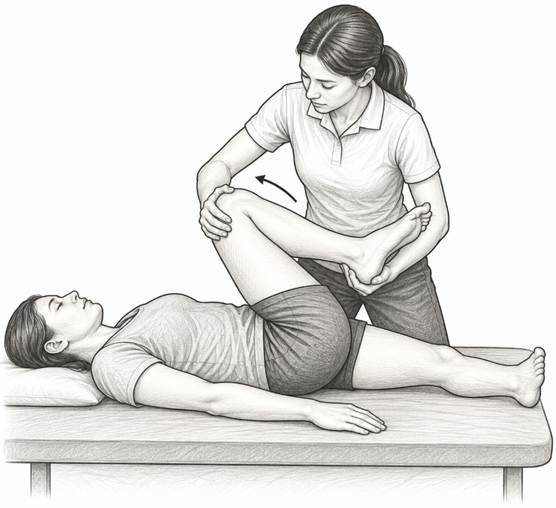
- Supine Manual Piriformis Stretching
Purpose: To improve the flexibility of a shortened or tight piriformis muscle with controlled assistance from the physiotherapist.
Starting position:
The patient lies supine on a treatment couch.
The affected hip and knee are flexed.
Procedure:
- The physiotherapist stands beside the affected limb.
- One hand supports and controls the affected knee.
- The other hand supports the ankle or distal lower leg.
- The physiotherapist gently moves the hip into flexion, adduction, and external rotation, as appropriate to the patient’s anatomy and tolerance.
- The stretch is gradually increased until mild resistance or a comfortable stretch is felt in the gluteal region.
- The position is maintained without bouncing or applying excessive force.
- The limb is slowly returned to the starting position.
Dosage: Hold for 20–30 seconds and repeat 3–5 times, adjusting according to the patient’s response.
Precaution: The physiotherapist should stabilize the pelvis and avoid excessive force, painful end-range movement, or aggravation of neural symptoms.
- Side-Lying Manual Piriformis Stretching
Purpose: To stretch the piriformis while the patient is positioned on the unaffected side.
Starting position:
The patient lies on the unaffected side.
The affected hip and knee are flexed comfortably.
Procedure:
- The physiotherapist stands behind the patient.
- One hand stabilizes the pelvis to prevent excessive pelvic rotation.
- The other hand supports the affected thigh or knee.
- The physiotherapist gently guides the affected hip into flexion and adduction, with the degree of rotation adjusted to the patient’s comfort and clinical findings.
- A mild stretch is maintained in the gluteal region.
- The limb is returned slowly to the starting position.
Dosage: Hold for 20–30 seconds and repeat 3–5 times as tolerated.
Precaution: Avoid excessive pressure on the knee and prevent unwanted rotation of the lumbar spine or pelvis.
- Prone Manual Piriformis Stretching
Purpose: To lengthen the piriformis by applying a controlled stretch to the hip in a prone position.
Starting position:
The patient lies in the prone position on a treatment couch.
The affected knee is flexed to approximately 90 degrees, if comfortable.
Procedure:
- The physiotherapist stands beside the affected limb.
- One hand stabilizes the pelvis.
- The other hand supports the lower leg.
- The physiotherapist gently guides the hip into internal rotation by moving the lower leg laterally, while maintaining the knee in a comfortable position.
- The movement is continued only until a mild stretch or appropriate resistance is felt.
- The position is maintained briefly, and the limb is returned to neutral.
Dosage: Hold for 20–30 seconds and repeat 3–5 times if appropriate.
Precaution: This technique requires careful control of the hip and knee. It should be avoided if it provokes hip joint pain or neurological symptoms.
References
- Kisner, C., Colby, L. A., & Borstad, J. (2017). Therapeutic Exercise: Foundations and Techniques (7th ed.). F. A. Davis Company.
- Dutton, M. (2020). Dutton’s Orthopaedic Examination, Evaluation, and Intervention (5th ed.). McGraw Hill.
- Neumann, D. A. (2017). Kinesiology of the Musculoskeletal System: Foundations for Rehabilitation (3rd ed.). Elsevier.
For more notes click on: www.physiotherapyphd.com

