
iliopsoas stretching techniques, including patient positioning, step-by-step instructions, stretching duration, precautions and benefits for hip flexibility and mobility.
The iliopsoas is a major hip flexor. It originates from the lumbar vertebrae and iliac fossa and inserts onto the lesser trochanter of the femur. Stretching is performed primarily through hip extension, with appropriate pelvic control, to improve hip mobility when the muscle is shortened or tight.
Uses
- To improve hip extension range of motion.
- To reduce restrictions associated with shortened hip flexor muscles.
- To facilitate activities such as walking, running and taking a backward step.
- To improve movement when hip flexor tightness contributes to restricted mobility.
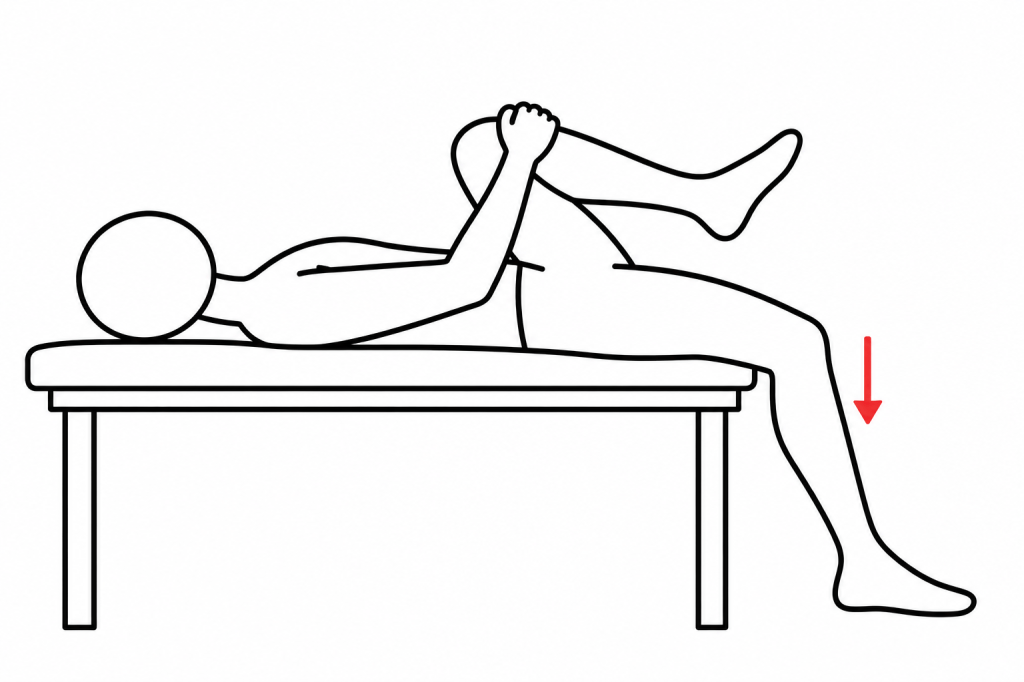
Starting position: The patient lies supine on a firm treatment table, with the hips positioned near the edge of the table.
Method
- Ask the patient to lie on their back near the edge of the treatment table.
- Ask the patient to hold one knee and pull it towards the chest.
- Allow the opposite thigh to lower towards the floor beyond the edge of the table.
- Keep the opposite leg relaxed and the pelvis stable.
- Maintain the position until a mild stretch is felt at the front of the hip.
- Hold for 20–30 seconds and repeat 2–4 times, as tolerated.
Precautions
- Avoid excessive arching of the lower back.
- Do not force the thigh downwards.
- Stop if sharp pain occurs in the hip, groin, or lower back.
- Use caution following hip surgery or in the presence of hip joint pathology.
Clinical significance: The Thomas test is commonly used to assess hip flexor tightness, whereas the Thomas stretch uses a similar position as a therapeutic intervention to improve hip extension. The test and the stretch are related but have different purposes.
Reference:
- Kisner C, Colby LA, Borstad J. Therapeutic Exercise: Foundations and Techniques. 7th ed. Philadelphia: F.A. Davis; 2018.
- Magee DJ. Orthopedic Physical Assessment. 7th ed. St. Louis: Elsevier; 2021.
For more notes click on: www.physiotherapyphd.com

