
Joint mobilization should be individualized according to the patient’s examination findings, joint restriction, irritability, treatment goal, and response.
The following principles provide a practical framework for safe and effective application.
1. Examination and Evaluation
- Perform a thorough assessment of pain, ROM, joint mobility, resistance, and irritability before mobilization.
- Identify whether the primary problem is pain, stiffness, hypomobility, or a combination.
- Reassess the relevant movement after mobilization to determine its effectiveness.
- The examination should guide the direction, grade, amplitude, and dosage of mobilization.
2. Capsular Restriction
- Determine whether limitation is due to capsular tightness or another structure.
- Identify the pattern and direction of restriction and mobilize the joint in the direction that addresses the identified impairment.
- Do not force movement through a painful or inappropriate restriction.
- Mobilization should be directed toward the specific mobility deficit, rather than applied routinely.
3. Positioning and Stabilization
- Position the patient and joint to provide maximum relaxation and optimal access to the joint.
- Stabilize one joint segment firmly while applying the mobilizing force to the other.
- Use a position that allows the desired accessory movement while minimizing compensatory movement.
- Maintain proper therapist body mechanics and hand placement for controlled force application.
4. Treatment Force and Direction of Movement
- Apply the force in the appropriate direction according to joint anatomy, arthrokinematics, and treatment objective.
- Control the magnitude, amplitude, and line of force throughout the technique.
- Grades I–II are generally used primarily for pain modulation, whereas Grades III–IV are used primarily to improve restricted joint motion.
- Avoid excessive force; the force should be sufficient to achieve the intended response without unnecessary pain or tissue irritation.
5. Initiation and Progression of Treatment
- Begin with a low-intensity, well-tolerated technique, particularly when the joint is painful or highly irritable.
- Progress gradually by changing grade, amplitude, force, range, or duration according to the patient’s response.
- Progress from less provocative to more intensive mobilization as symptoms and mobility permit.
- Treatment should be progressed only when the previous level is well tolerated and clinically effective.
6. Speed, Rhythm, and Duration of Movements
- Use a smooth, controlled, and consistent rhythm rather than abrupt movements.
- Adjust oscillation speed and amplitude according to the treatment objective and patient tolerance.
- Treatment dosage includes grade/force, amplitude, rate, rhythm, duration, repetitions, and treatment frequency.
- There is no single optimal dosage for all joints or conditions; dosage should therefore be individualized and reassessed.
7. Patient Response
- Continuously monitor pain, discomfort, muscle guarding, relaxation, and symptom behavior during treatment.
- A desirable response is improved movement or reduced symptoms without excessive post-treatment aggravation.
- If symptoms worsen or the technique is poorly tolerated, reduce the intensity, modify the technique, or discontinue it.
- Reassess ROM and symptoms immediately after treatment to determine whether the mobilization produced the intended effect.
8. Full Treatment Program
- Joint mobilization should be incorporated into a complete physiotherapy program, rather than used as an isolated intervention.
- Combine appropriate mobilization with therapeutic exercise, active ROM, stretching, strengthening, functional training, and patient education when indicated.
- Treatment frequency and duration should depend on the patient’s impairment, response, and functional goals.
- The program should be regularly reassessed and modified according to progress.
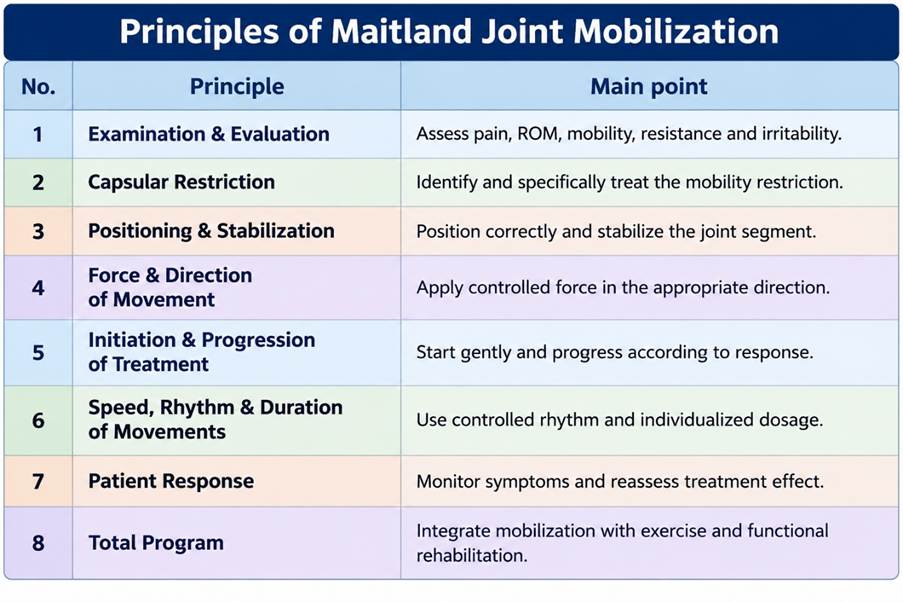
Core principle: Examine → identify the restriction → position and stabilize → select force/direction and grade → apply appropriate dosage → monitor response → reassess → progress or modify treatment.
Principles of joint mobilization
Get All Physiotherapy Notes & Updates — Enter email and Follow
Reference:
- Levangie, P. K., & Norkin, C. C. (Eds.). (2011). Joint structure and function: A comprehensive analysis (5th ed.). F.A. Davis Company.
- Kisner, C., & Colby, L. A. (2007). Therapeutic exercise: Foundations and techniques (5th ed.). F.A. Davis Company.
For more notes click on: www.physiotherapyphd.com

