
This topic includes detailed Explanation and Definition of Peripheral Joint Mobilization, Uses, Grades of Mobilization.
Definition of joint mobilization: Joint Mobilization is define as passive, skilled manual therapy techniques applied to joints and related soft tissues at varying speeds and amplitudes using physiological or accessory motions for therapeutic purposes.
Use of joint mobilization:
1. Pain, Muscle Guarding, and Spasm
Painful joints, reflex muscle guarding, and muscle spasm can be treated with gentle joint-play techniques to stimulate neurophysiological and mechanical effects.
2. Reversible Joint Hypomobility
Reversible joint hypomobility can be treated with progressively vigorous joint-play stretching techniques to elongate hypomobile capsular and ligamentous connective tissue.
3. Shortened Capsular and Ligamentous Tissue
Sustained or oscillatory stretch forces are used to mechanically distend shortened tissues like capsular and ligamentous tissues.
4. Malposition and Faulty Joint Tracking
Malposition of one bony partner with respect to its opposing surface may result in limited motion or pain. The malpositioning resulting in pain or limited motion. MWM techniques help to realign the bony partners while the person actively moves the joint through its ROM. Manipulations are used to reposition an obvious subluxation, such as a pulled elbow or capitate-lunate subluxation.
5. Progressive Movement Restrictions
Diseases that progressively limit movement can be treated with joint-play techniques to maintain available motion or retard progressive mechanical restrictions.
6. Prevention of Effects of Immobility
When a patient cannot functionally move a joint for a period of time, the joint can be treated with nonstretch gliding or distraction techniques to maintain available joint play and prevent the degenerating and restricting effects of immobility
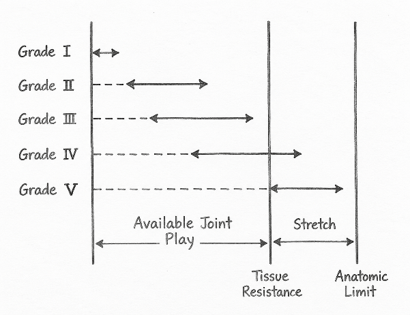
Grades of joint Maitland mobilization:
Grade I: Small, gentle rhythmic movements are performed at the beginning of the joint’s range of motion.
Grade II: Large rhythmic movements are performed within the joint’s range of motion, without reaching the end of the range.
Grade III: Large rhythmic movements are performed up to the end of the available range and stretched into the tissue resistance.
Grade IV: Small rhythmic movements are performed at the end of the available range and stretched into the tissue resistance.
Grade V: A small-amplitude, high-velocity thrust is performed at the end of the available range to break adhesions. This technique requires advanced training.
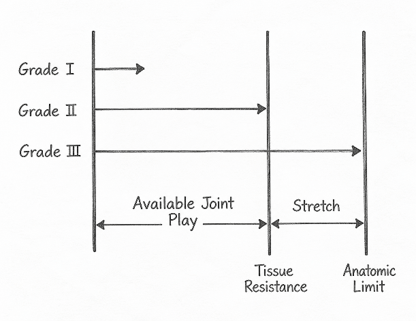
Grades of sustained mobilization technique:
Grade I (Loosen): Small-amplitude distraction is applied without putting stress on the joint capsule. It helps reduce the effects of cohesive forces, muscle tension, and atmospheric pressure acting on the joint.
Grade II (Tighten): Enough distraction or glide is applied to tighten the tissues around the joint. This is called “taking up the slack.”
Grade III (Stretch): Distraction or glide is applied with a large enough amplitude to stretch the joint capsule and surrounding tissues.
Get All Physiotherapy Notes & Updates — Enter your email and Follow
Reference:
- Levangie, P. K., & Norkin, C. C. (Eds.). (2011). Joint structure and function: A comprehensive analysis (5th ed.). F.A. Davis Company.
- Kisner, C., & Colby, L. A. (2007). Therapeutic exercise: Foundations and techniques (5th ed.). F.A. Davis Company.

